
TRANSFORMING MILITARY PILOT TRAINING
THROUGH IMMERSIVE SIMULATION
EXECUTIVE SUMMARY
Modern military pilot training demands more than technical proficiency—it requires efficient methods for preparing students to operate in increasingly complex environments while maximizing the value of limited flight hours. Working alongside United States Air Force instructor pilots and training organizations, Flux Mechanics developed immersive virtual reality and 360-degree training solutions designed to supplement existing flight training programs. By combining subject matter expertise from experienced instructors with immersive technologies, the project focused on improving procedural familiarity, environmental awareness, and student preparation before entering the aircraft. The result was a scalable training capability that complemented traditional instruction while demonstrating how emerging technologies could be integrated into established military training pipelines.
THE CHALLENGE
Military pilot training is built around limited aircraft availability, demanding schedules, and carefully structured instruction. Every flight hour is valuable, leaving students with limited opportunities to repeatedly practice procedures, cockpit familiarization, and mission preparation before entering the aircraft. While classroom instruction provided the necessary academic foundation, there remained an opportunity to reinforce learning through immersive, hands-on experiences outside of scheduled flight operations.
At the time, virtual reality had not yet established a proven role within military aviation training. Few examples existed demonstrating how immersive technology could be integrated into an operational training pipeline without disrupting established instructional methods. Any solution would need to complement—not replace—the expertise of instructor pilots while accurately reflecting the procedures, standards, and learning objectives already in use throughout the Air Force.
The challenge was not simply developing virtual reality software. It was understanding how military aviators learn, identifying where immersive technology could provide meaningful value, and building solutions that instructors trusted enough to incorporate into real-world pilot training.
OBJECTIVES
The project was developed with a clear objective: enhance existing Air Force pilot training without altering the instructional methods already established by instructor pilots. Rather than replacing classroom instruction or flight training, immersive technology would provide students with additional opportunities to build familiarity, confidence, and procedural understanding before entering the aircraft.
To achieve this, every training application was designed around five core objectives:
Reinforce existing classroom instruction through immersive learning.
Improve cockpit, aircraft systems, and procedural familiarization.
Increase student confidence prior to flight operations.
Accurately represent real-world instructional techniques and operational procedures.
Integrate seamlessly into existing Air Force training pipelines with instructor acceptance rather than disruption.
DEVELOPMENT PROCESS
This is where the case study becomes unique. Instead of focusing on the technology first, every project began by understanding how instructor pilots taught, how students learned, and where additional training opportunities existed. Before a single application was developed, significant time was spent observing instruction, documenting procedures, and working directly with subject matter experts to ensure every lesson reflected real operational practices.
Development followed an iterative process built around continuous collaboration. Prototype applications were reviewed by instructor pilots, refined through direct feedback, and repeatedly tested until the content accurately represented classroom instruction, cockpit procedures, and mission workflows. Every decision—from user interaction to visual presentation—was driven by instructional value rather than technological novelty.
This collaborative methodology allowed immersive technology to become a practical extension of existing training rather than a separate system. By aligning development with established instructional objectives, each application strengthened student preparation while earning the confidence of the instructors responsible for training the next generation of Air Force pilots.
RESEARCH & DISCOVERY
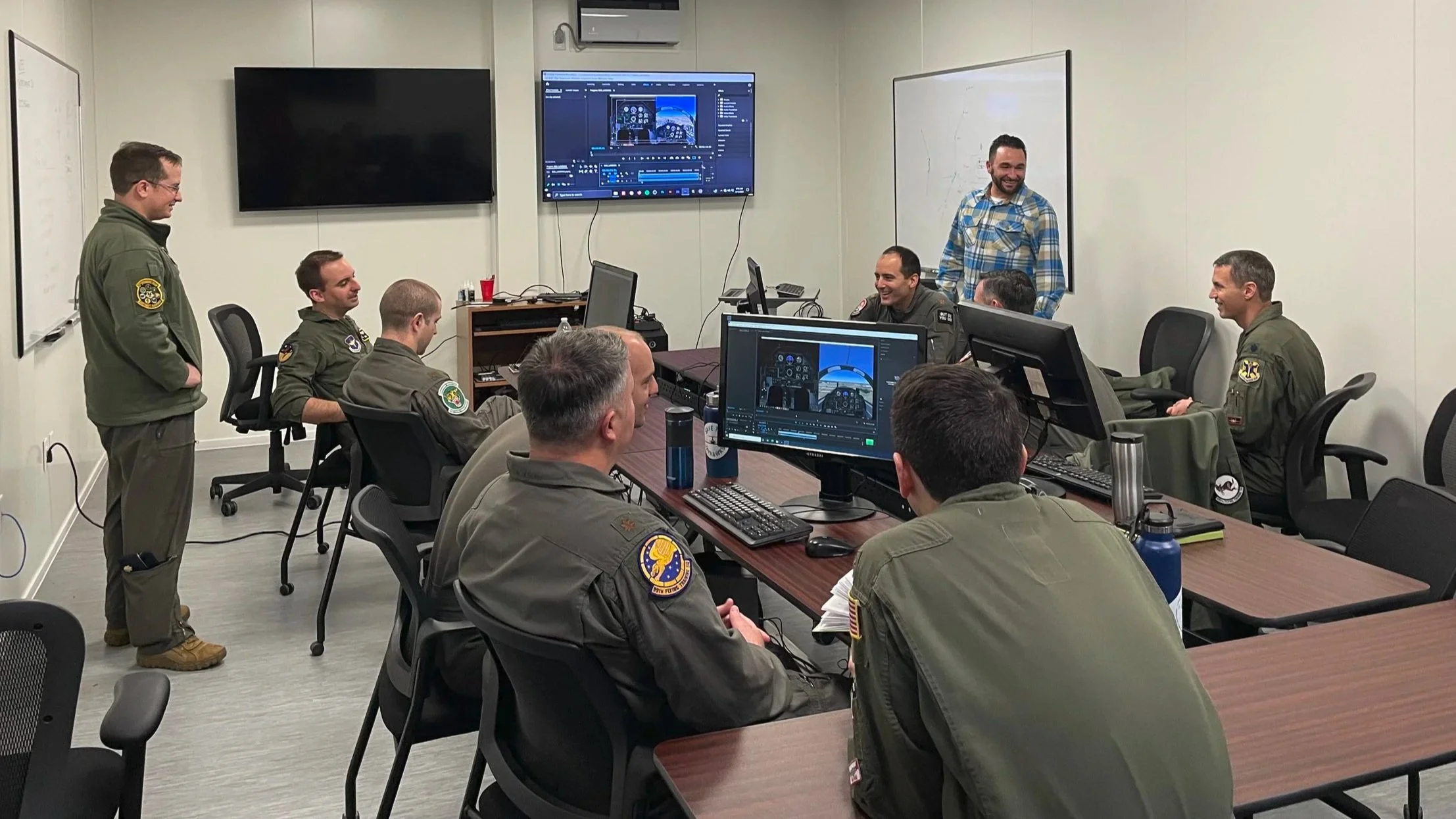
Before development began, the focus was not on software—it was on understanding the training environment. Working directly alongside instructor pilots, subject matter experts, and aircrew provided firsthand insight into how each course was taught, where students encountered difficulties, and which concepts would benefit most from immersive reinforcement.
Research extended beyond classroom observation. Flight operations, aircraft procedures, instructor briefings, and mission workflows were documented through direct participation and on-site production. Capturing authentic operational environments ensured every virtual experience reflected the same procedures, terminology, and instructional standards students would encounter during training.
This discovery process established the foundation for every application that followed. Rather than introducing technology into the classroom and searching for a purpose, development began by identifying real instructional challenges and designing immersive solutions specifically to address them.
CONTENT DEVELOPMENT
This phase transformed operational knowledge into immersive learning experiences. Working directly with instructor pilots and subject matter experts, each application was built to accurately represent aircraft systems, cockpit procedures, emergency operations, and mission workflows while remaining aligned with established instructional methods.
Content development extended beyond software engineering. Flight operations were captured using 360-degree video, interactive media, and custom visual assets, then integrated into virtual reality applications that allowed students to explore procedures repeatedly before entering the aircraft. Every lesson balanced technical accuracy with instructional usability, ensuring technology supported learning rather than distracting from it.
Applications were refined through continuous instructor feedback, allowing procedures, interactions, and visual presentation to evolve alongside operational requirements. This iterative process produced training experiences that instructors trusted because they reflected the same techniques and standards used throughout the Air Force training pipeline.
VALIDATION & TESTING
Rather than evaluating success through technical performance alone, every application was validated through operational use with instructor pilots and subject matter experts. Prototypes were demonstrated, reviewed, and refined using direct feedback from the personnel responsible for training the next generation of Air Force aviators.
Testing focused on instructional effectiveness rather than software features. Lessons were evaluated to ensure procedures, aircraft systems, emergency operations, and mission workflows accurately reflected real-world training while remaining intuitive for students with varying levels of experience.
This continuous validation process built instructor confidence and encouraged adoption across multiple Air Education and Training Command programs. As applications matured through repeated testing and operational refinement, immersive technology evolved from an experimental concept into a trusted supplement to established Air Force pilot training.
RESULTS & IMPACT
The project expanded across multiple Air Education and Training Command programs, supporting Undergraduate Pilot Training, Combat Systems Officer Training, Pilot Instructor Training, Introduction to Fighter Fundamentals, Advanced Instructor Course, and additional specialized aviation training initiatives. What began as focused development efforts evolved into a proven framework for designing immersive training solutions through close collaboration with instructor pilots, subject matter experts, and operational units across the Air Force training pipeline.
By demonstrating measurable instructional value, immersive technology gained acceptance beyond isolated demonstrations and became integrated into established training workflows. These applications enabled students to build cockpit familiarity, procedural knowledge, and operational confidence before entering the aircraft, allowing valuable flight hours to focus on advanced instruction rather than basic procedural repetition while improving the overall efficiency of pilot training.
From the outset, the objective was clear: improve pilot training while reducing the cost of producing combat-ready aircrew. Rather than relying exclusively on expensive aircraft sorties and legacy simulators for foundational instruction, immersive technology shifted cockpit familiarization, emergency procedures, mission rehearsal, and systems training into scalable virtual environments where students could train repeatedly at a fraction of the cost of live flight operations. This approach increased readiness, improved instructor effectiveness, reduced dependence on limited aircraft availability, and maximized the value of every aircraft, instructor, and training dollar.
As these concepts matured across Air Education and Training Command, immersive training became a cornerstone of the Air Force's broader modernization strategy to increase pilot production while controlling long-term operating costs. Enterprise implementation has since demonstrated measurable results, including compressed training timelines, replacement of multi-million-dollar legacy training devices with low-cost immersive systems, reduced reliance on aircraft for procedural instruction, and documented annual cost savings measured in the tens of millions of dollars. These outcomes validated that immersive technology is not simply an instructional enhancement—it is a scalable, operationally proven strategy for increasing readiness, expanding pilot production, and fundamentally reducing the cost of military aviation training.
Beyond the software itself, the project's enduring contribution was demonstrating that meaningful innovation begins with operational requirements, not technology. Every solution was developed alongside instructor pilots, validated in operational environments, and refined through continuous feedback before deployment. That philosophy established a repeatable model for modernizing aviation training—one that continues to help military organizations produce better-prepared aviators, maximize limited resources, and achieve more with every training dollar.
CONCLUSION
The future of military aviation training will be shaped by organizations that can increase readiness while making more effective use of limited resources. Immersive technologies provide a practical path toward that future by extending instructor expertise, reducing dependence on costly aircraft for foundational training, and preparing students more effectively before they ever enter the cockpit.
This project demonstrated that successful innovation is not driven by technology alone. Lasting change requires close collaboration with instructors, operational validation, iterative development, and a clear understanding of the training mission. By placing operational requirements at the center of every design decision, immersive technology became a force multiplier rather than a replacement for traditional instruction.
The principles established through this work continue to guide Flux Mechanics' approach to aviation training consulting. Whether supporting major military organizations or smaller air forces seeking to modernize within constrained budgets, the objective remains the same: develop immersive training solutions that improve readiness, maximize training effectiveness, and reduce the long-term cost of producing highly capable aviators.